Inspired by old(er) men

So here I am almost 65; my doctor tells me the time has come for colonoscopies, prostrate exams and other essential routines for the aging.    I ended my CEO role at iDE this year, and it was said that I was retiring, along with the implicit expectation that useful life is drawing to a close.  Not sure that I am prepared to accept that; and to bolster the argument,  I find plenty of inspiration from men somewhat older than I am!cohen

I will start with 78 year old Leonard Cohen.  We paid a fair amount of money to sit in the second row at a recent concert.  It was worth every cent to hear and see him perform – a concert which lasted over three hours!  I doubt there was a song which I had not heard often before; he moved around the stage with ease, bowing to the audience, dropping to his knees at times and generally giving the audience the impression that we were the most special and important audience he had ever performed for.

We were both a lot younger when I first began to listen to Cohen; his assertion that “there’s a crack in everything – that’s how the light gets in” has always been comforting when not every endeavor went according to plan.  (Not sure what it means to “first we take Manhattan, and then Berlin” but it was fun to live in Germany and to contemplate the latter).  I find his recent exploration of impending mortality in his album “Old Ideas” to be both cathartic and inspiring.

I also listened to 79 year old Willie Nelson this year.  Loved his album “Heroes”.  In “Come On Up to the House” he invites us to “come down off the cross – we can use the wood…”  No room for self-pity in his paradigm – only the dedication to producing beautiful poetry and music as he approaches 80.  There is a longing for salvation as sings “Come back Jesus and pick up John Wayne on the way.”

And then there was the Neil Young concert at Red Rocks Amphitheatre.  Neil is only 68 but still plays his guitar as though he was 20, and still is committed to “Waging Heavy Peace”.  I might be a little biased because of Neil’s Winnipeg roots (at least for a while), but mostly I am impressed that his commitment to inspiration just doesn’t stop.

It isn’t just aging rock stars who have inspired me.  The iDE board has a number of near octogenarians, including Jack Keller, Lester Woodward, Paul Polak, Norm Fiske and Bill Fast.  Jack Keller is the most senior, but his mind is sharp and his professional engagement is awesome.  Lester Woodward has an amazing combination of good humor and solid wisdom.  Paul Polak reckons to still establish four multinationals each with 100 million poor customers and $10 bn in sales.  Norm Fiske has the ability to comprehend even the messiest financial statements in but a few minutes.  Bill Fast has an indefatigable curiosity that keeps him involved in venture after venture.    I don’t think that any of these five own rocking chairs; if they did, they wouldn’t know what to do with them.  Each of them inspire me.

So no retirement for me – just the space to do interesting things.  A little more exploration of markets.  A partnership with my camera lens.  The company of other old(er) men.

Al Doerksen
Posted in Personal | Tagged , , , , , , | 3 Comments

Sweat Equity and Market Access in Nepal

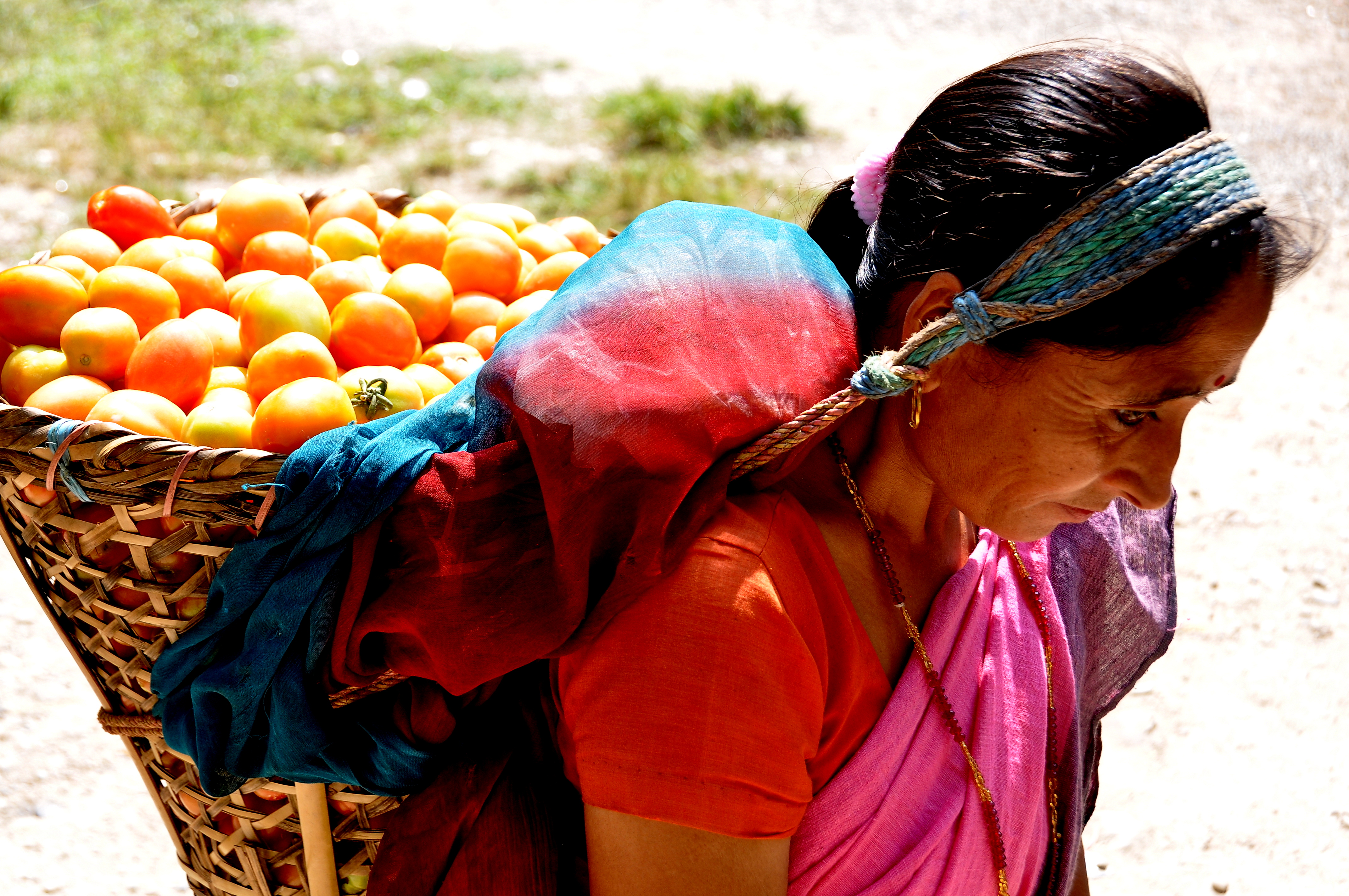
It was a warm day in October in the hills/mountains near Pokhara, Nepal.  I was sweating.  I wasn’t even doing much except standing there with my camera enjoying the scenery.  Then a woman came up the hill from the steep grade below.  She was sweating too, and no wonder – she was carrying a basket of tomatoes on her back supported only by a strap which ran across her forehead.  She was heading to one of the more than 100 collection centres iDE Nepal has organized over the past few years.Image

She put the basket of tomatoes on the ground.  I tried to lift it to see just how heavy it was.  I wasn’t so successful but with the help of a friend, we got the basket onto the scale in the centre; it was 35 kilos (77 lbs!).  She had been walking and climbing for about an hour – no wonder she was sweating.

She was a Nepalese farmer.  She and the other farmers (mostly women) at the collection centres had worked hard to grow the tomatoes, pumpkins, squash, white radishes, brinjal and other produce which they had the opportunity to bring to these collection centres once or twice a week.

The good news is that their agricultural efforts are yielding a lot more food than their own families can consume.  The bad news is that they are some distance (lots of miles) away from the regional markets where these can be sold.  The good news is the community organized, run and led collection centres offer fair market access for those rural, remote farmers.  Most collection centres have chalk or white boards which post the market prices in Pokhara (or other markets ) the day before, and on the current day.  [All made possible by the ubiquitous mobile phones].  Collection centres allow the local farmers to engage with local traders (with access to transport) to sell off 100% of their produce for prices better than 90% of the regional markets.  It’s a good deal.  For the local traders it’s a good deal too – rather than having to go around to buy produce from a range of remote farmers, they can show up in one place to quickly buy fresh produce for immediate transport and sale in regional markets.

If every farmer was responsible to take their own production all the way to local markets, it would be too time consuming and too expensive (in terms of transportation costs) to make it worthwhile.  Further, as a sole producer in the local market place, they would have no assurance that they could sell all of the produce on a timely basis for a fair price.Image

Collection centres are producer marketing cooperatives.  The market access they provide ensure a profitable return on agricultural activities in the hills.  They are efficient, but they also represent the opportunity for the women and men who use them to gain access to the income which is key to realizing other dreams and hopes.  For iDE, the collection centres are just one more example that sustainable gains in household income and livelihoods are possible through a market based approach to development.

Al Doerksen – October 2012

Posted in IDE | Tagged , , , , , | 1 Comment

My Cow Wears a Necklace

So I’m travelling in India, and thinking that this would be a good time to buy a gold necklace.  After all, there is probably no country in which there is as much investment in gold jewelry as in India.  But then I remembered that the price of gold is rather high right now, so I decided not to invest.

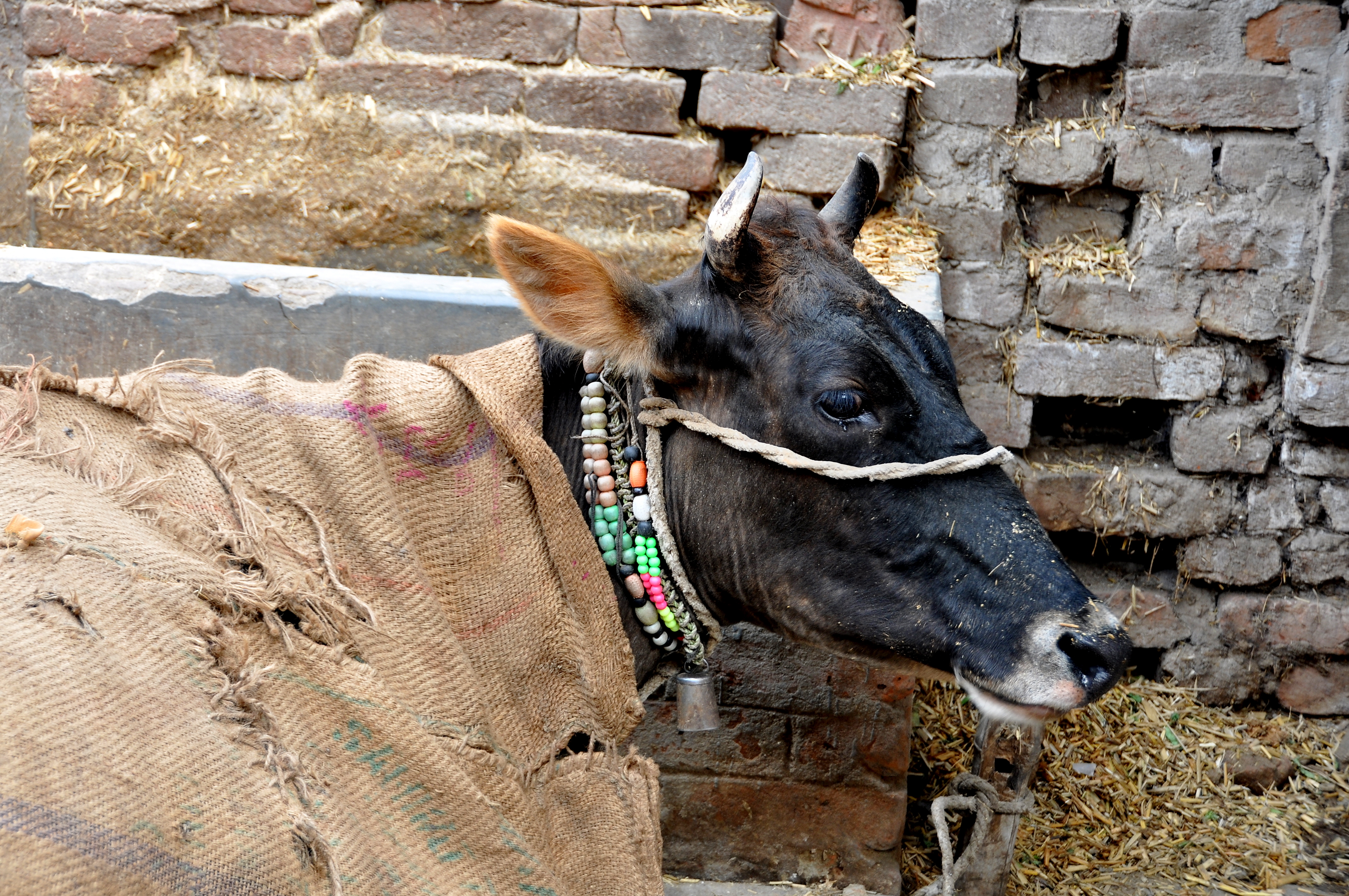
I was not expecting, however, to encounter cows wearing necklaces (and blankets) in Bihar.  Not just one or two, but rather a lot of cows with brightly colored strands of beads.  Not gold but necklaces nevertheless!

The obvious hypothesis is that cows, being considered somewhat akin to holy, should thus be adorned as gestures of divine reverence.  I don’t think that is the explanation, however.

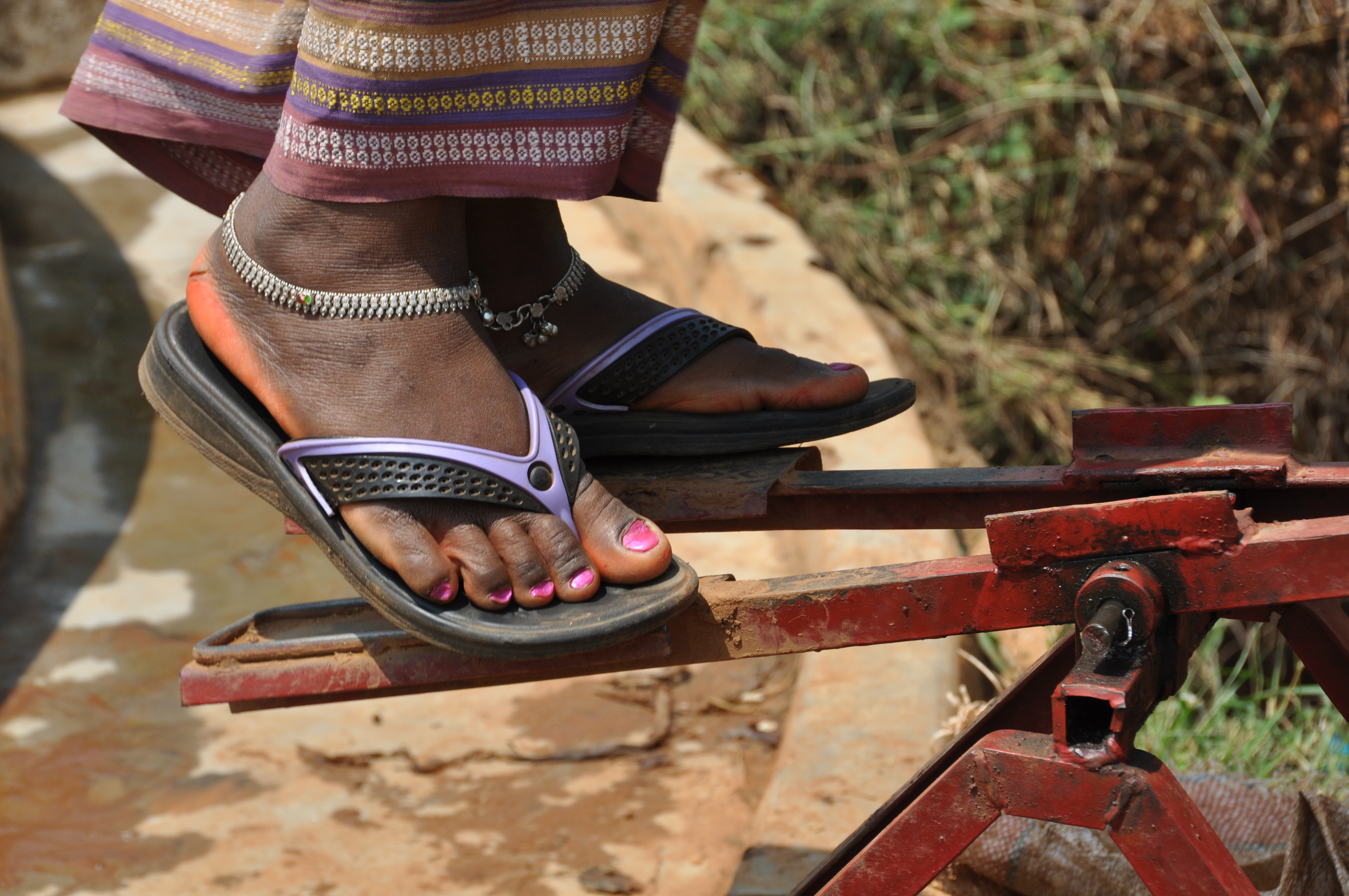
The real answer begins in the field of the smallholder farmer and owner of this cow.  My picture here shows a treadle pump in a field of vegetables being grown in the post-monsoon season.  Cauliflower, carrots, beets, potatoes, etc – all fetch a good price in this season.  The simple treadle pump combined with some sensible agronomic practice has resulted in a significant increase in productivity, that is, a lot more food grown and a lot more income produced.  Not just one or two farmers.  Lots.

These Bihari farmers often invest next in a cow or water buffalo.  A bunch of reasons to do this:  milk production, animal traction, farm saving and dung production.  So the smallplot farmer with his/her treadle pump can capitalize his/her farm operation through the investment in a cow.    Adult cows in Bihar are worth as much as $400 or more if healthy.

It is winter in Bihar at present (January) and the nights get a bit chilly.  I don’t know if this is truly necessary but I saw a lot of cows wearing “coats” for warmth, in addition to their necklaces.  From the farmers’ perspectives, these animals are so important that one should make the effort in treating them with respect and consideration.

Now, I don’t actually own a cow, and if I did, I doubt that it would actually wear a necklace.  Nevertheless, if I walk a little in the footsteps of the smallholder farmers using treadle pumps to increase their incomes and household asset base, I can begin to appreciate just how valuable the opportunity get ahead a little is.  And if putting a necklace on a valuable farm animal which it was thus possible to acquire with the earnings, then I am fully on side!

Al Doerksen

Posted in IDE, Personal | Tagged , , , | 3 Comments

Give me a place to squat … World Toilet Day 2011

In one of my former lives, I (and my family) spent three years in India.  Our work took us all over the country, both urban and rural areas.  I still remember driving the country roads in the dusk of early evenings, and seeing sari-clad women walking along the road with brass containers in their hands.  They were headed out to the fields to the privacy afforded by the darkness so they could finally, at the end of the day, perform their daily ablutions, as they were called.  Somehow they had waited the entire day before they could finally seek relief.

Talk about defecation, taking a crap, or taking a shit is not polite dinner-time conversation.  It may not even be polite for a blog seeking readers who appreciate a measure of respectability.  But that is part of the problem.  Even though most of us hope for the regularity which allows for a daily movement of our bowels, it is not usual to discuss it.  And the fact that we don’t talk about or even acknowledge that we did or didn’t crap today has contributed to not addressing the problem of one billion people who still defecate in the open every day!  We are going to have to start talking about this so we can get on to addressing the issue. 

iDE has been involved in sanitation marketing in Vietnam and Cambodia for several years, and successfully so, but I wasn’t always been convinced that iDE with its income creation mission should be involved in water & sanitation programs.  I have changed my mind.  I’ll tell you why.

It’s a health issue.  Open defecation and unsanitary latrines are a huge source of fecal matter in food which then leads to diarrheal disease.  Never mind the inconvenience this causes adults, diarrheal disease kills more than 1.5 million children a year!  It’s incredibly sad to lose a little person in this way!  The grandfather in me can easily identify with this pain.

It’s a women’s issue.  Women should not have to suffer the indignity, the inconvenience and the personal safety risks associated with open (field) defecation.  They should also not have to wait until nightfall to deal with their daily physical routines.

It’s a children’s issue.  Chronic diarrhea can hinder child development by impeding the uptake of essential nutrients that are critical to the development of children’s minds, bodies, and immune systems.   Reduced incidence of diarrhea has the effect of increasing school attendance, especially for girls.

It’s an economic issue.  In a recent policy statement, the Gates Foundation estimated that the economic benefits of improved sanitation can reach $9 for every dollar invested by increasing people’s productivity, reducing healthcare costs, and preventing illness, disability, and early death. For an organization like iDE with a focus on creating income opportunities, this is huge.

It’s a market opportunity.  Several years ago, iDE Vietnam engaged in a project to help local suppliers construct and supply low cost latrines through the local market place.  A post-project evaluation conducted 3 years after the close of the project showed that high latrine sales rates continued even though the project was long over.  More recently, iDE Cambodia working with an IDEO product designer developed a simple, award winning “easy latrine.”  In the first year after this was introduced to local producers and marketers, more than 10,000 units were sold and installed (and are now in daily use).  These units sell because they align with the value structure of our customers.

iDE is gratified to report that the Bill & Melinda Gates Foundation,  the Stone Family Foundation, and the World Bank Water and Sanitation Program have recognized iDE’s leadership and proficiency in sanitation marketing with $6 million in grant funding to  expand our work in Southeast Asia.  We are poised to also move into Nepal, Bangladesh, and several African markets.

One of iDE’s historical heroes is Archimedes.  He said “give me a lever long enough, and a place to stand, and I will move the earth.”  We think a good variation of this might be “give me a place to squat (in dignified privacy, safety, and convenience), and I will move my bowels to change the world.”

Posted in IDE | Tagged , , , , , | 4 Comments

The poor pay more for their food, and they work harder too…

Hunger in Africa has been on my mind recently.  FAO has been reporting that food prices have spiked to record levels.  Worse, reports of famine in Somalia have been circulating – real true famine with people not just hungry, but starving.  Starving means that the body starts to feed on itself just to survive.

I am a big believer in Amartya Sen’s analysis (in his essay “Poverty and Famines”) that by far the largest cause of hunger and starvation in a famine event is not because of inadequate food supply – people become hungry and starve when they cannot access the food which is available.   Sen analyzed food supplies in some of most famous famines including the Irish potato famine in 1845/51, or the Bengal famine in India in 1942, or the
Bangladesh in 1973.  Each of these famines had different underlying causes, but most importantly, in all cases, there was enough food to supply everyone.  No one had to starve.

What then are the factors which deny access to food to hungry people?  Well, in the first case, there are nasty civil conflicts as is the case in Somalia – starvation of people is being used as a weapon.  Hoarding by merchants or by wealthier households is a factor too.

By far and away, however, the biggest reason people cannot access the food they need is because they are too poor.  In plain English, they do not have enough money to buy the food they need.

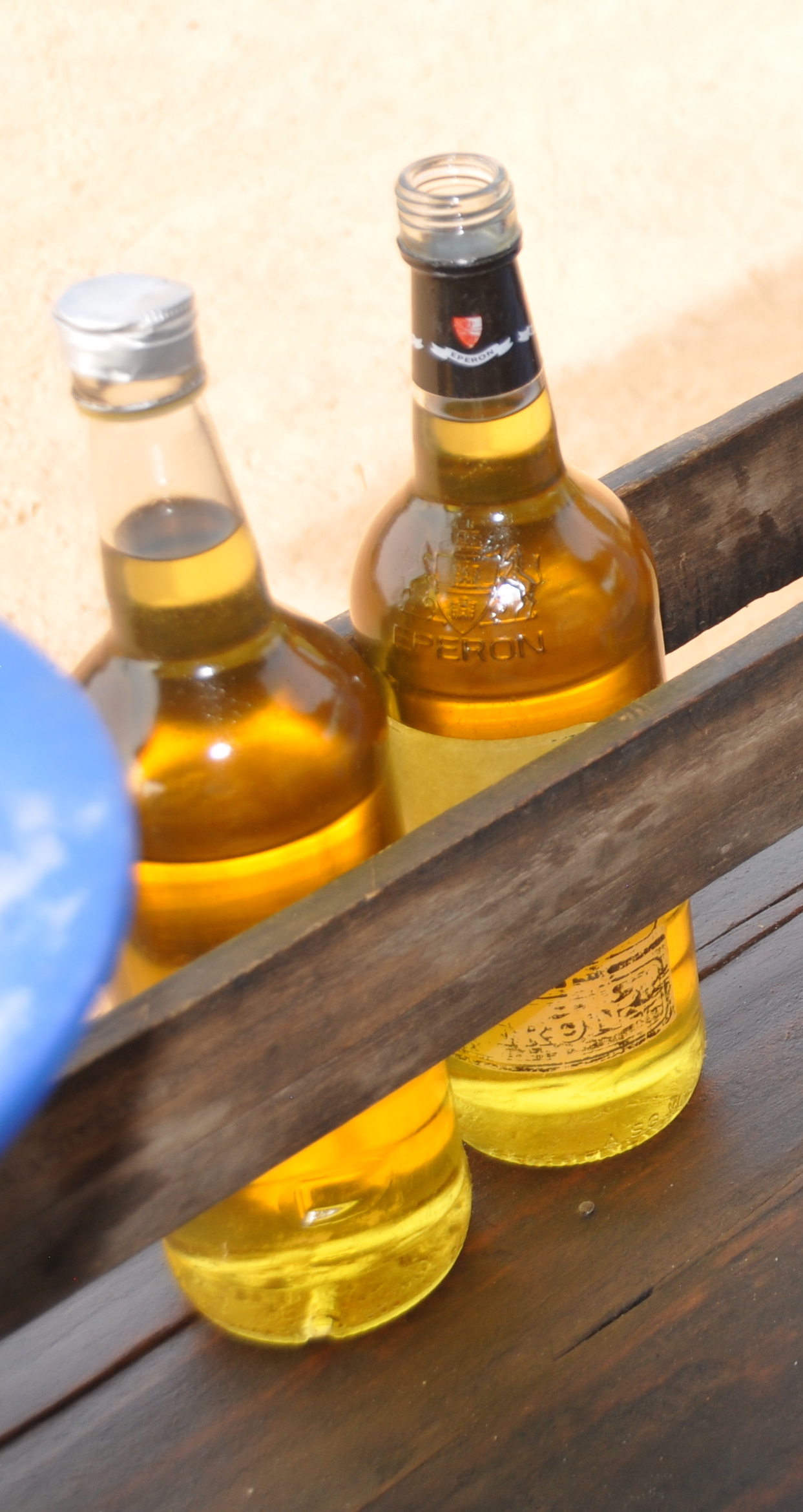
This last week I was in Burkina Faso.  I had the chance to “get lost” in a village community with my camera, and when this happens, I look for examples of market activity, ie, local buying and selling.   Simple stands where someone is selling few vegetables, or salt, or litre bottles of cooking oil are common.  Oil is daily necessity – I was quoted 1000 Cfa (just over $2 USD) for a one litre bottle.

This is probably a fair price for palm oil, but if you are a $1 – 2/day household, you simply may not have the free cash (working capital) to buy an entire litre at a time.   Local traders’ response to this situation to repackage oil (and many other commodities) into smaller, affordable quantities.  You can buy a small packet for just today.  This is useful.

But here’s the rub. If you buy oil in smaller packets (out of necessity), you end up paying
20% more for your cooking oil as compared to the 1 litre bottle.  So not only are you poor, but now your food bill for oil is 20% more expensive. Ouch.  This is the pain of food
insecurity.

[On the other hand, middle class North American consumers without real cash constraints, can secure 10% case discounts at Costco or Whole Foods.]

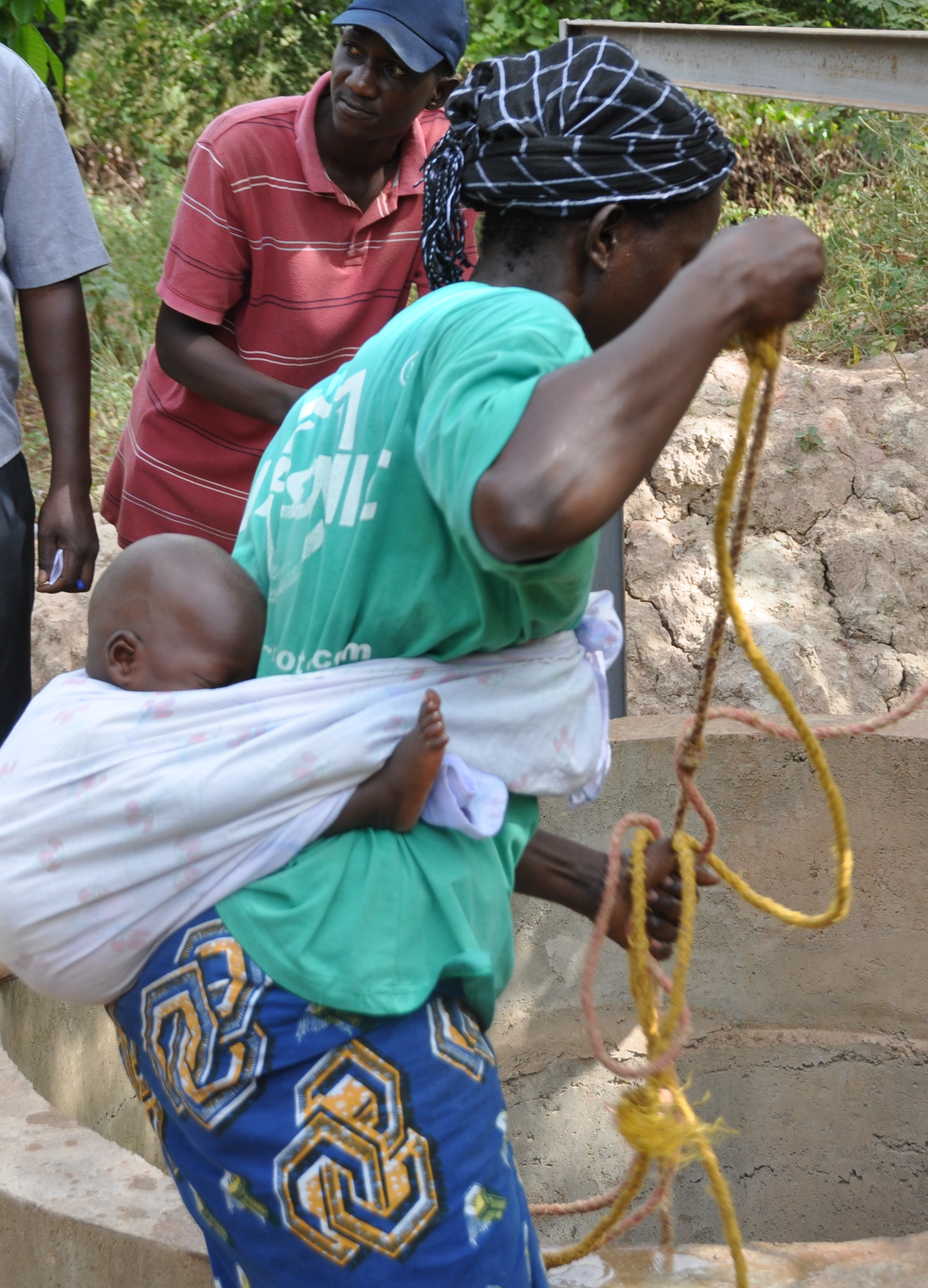
What I also saw in Burkina Faso last week, was a woman with an infant strapped to her back drawing water with a rope and bucket from an open well to fill sprinkler cans with water, then walk two cans at a time to irrigate her
vegetables.  This is hard work.

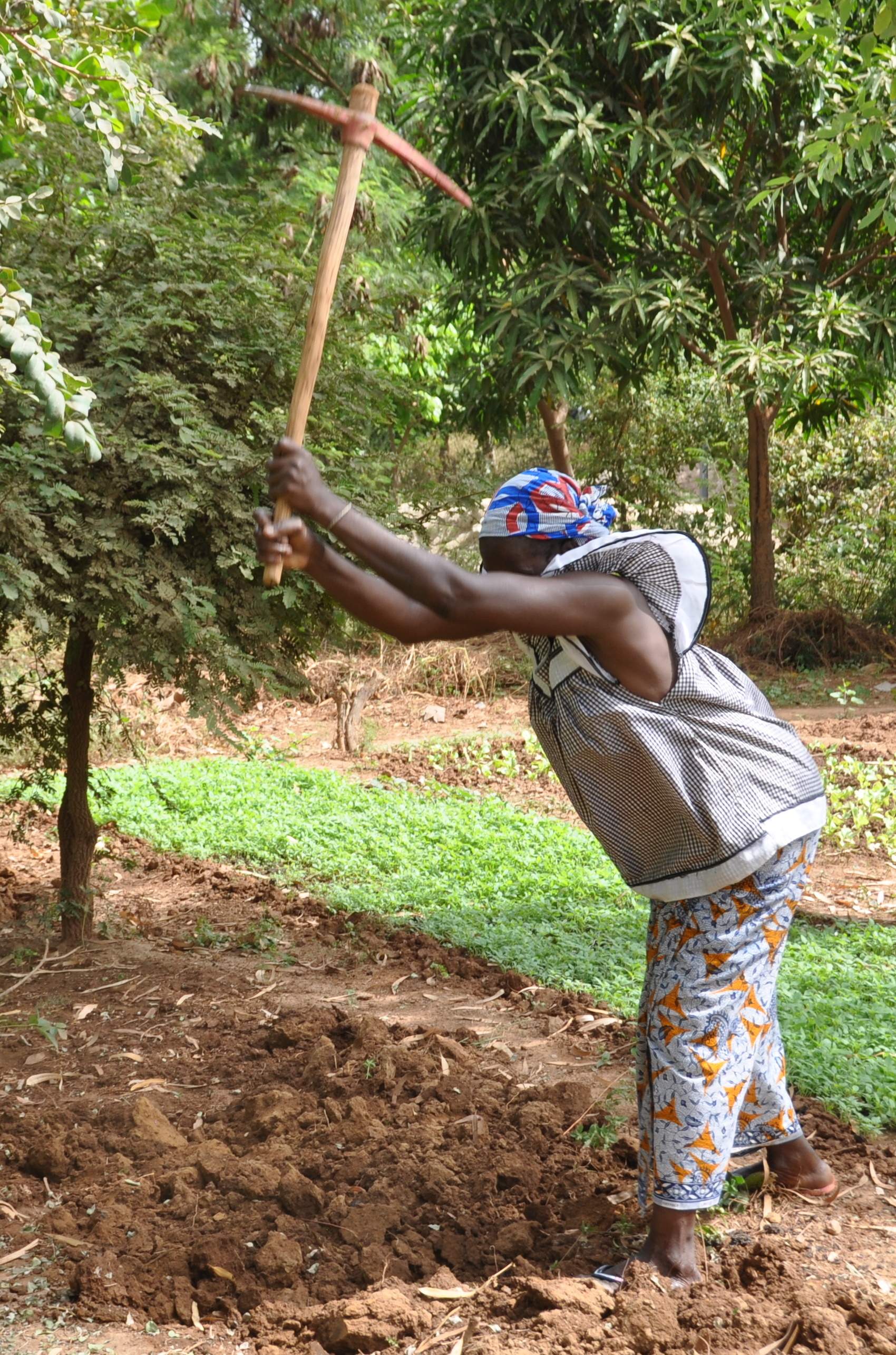
I saw another woman tilling her garden with a pick axe – try cultivating even a quarter acre in this way. I also saw a lot of women bent over weeding their gardens.  These are women working incredibly hard to grow a little food and earn a little income.  What they really need are opportunities to be more productive – to farm larger areas with less effort and with better yields.

Drip systems, suction pumps, diesel pumps, two wheeled tractors, animal traction, better seeds, affordable fertilizers, better agronomic practice – all of these can help subsistence farmers become more productive.  iDE is committed to making all of these available.  iDE believes that the way the subsistence households can escape this penalty of higher food prices is to put more income into the pockets of these consumers through opportunities for improved productivity – so they don’t need to pay 20% more for their cooking oil than
you and I.

Al Doerksen – October 2011

Posted in IDE, Personal | Tagged , , , , , , , | 1 Comment

The girl with the dirty finger nails

Don’t get me wrong. iDE has a careful hiring process.  We review resumés.  We do multiple interviews.  We check references.   Still, it’s often hard to spot the right candidate.  So when I saw the dirty fingernails, I knew we had found the candidate we were after.  Her hands looked like she had been busy with some motor oil intensive maintenance project.
We had found an engineer who was not afraid to get her hands dirty!

Ashley came to iDE from MIT in mid-2008.  She was looking for some international work
experience.  So off to Ethiopia she went to become part of iDE’s technology development team.  She said that getting a job with iDE was her dream job.  [And she explained that her fingernails were dirty because she was finishing a charcoal project].

It wasn’t always easy but Ashley was determined to fit in culturally. No foreign enclave for her.  She lived across town and took local buses to work.  She was robbed or scammed several times, but not only did she survive, she bounced back.  She enjoyed enjera, and learned traditional Ethiopia shoulder-jogging dancing.

In January 2009, I visited her in Ethiopia, and then wrote back to her parents (and now to all of you) that “You should know that Ashley is doing (has done) terrific work in Ethiopia. On the technical side, her determined drive to create a rope pump which will be affordable and viable and effective for smallholder families / farmers to help them  irrigate their crops, increase their food production and ultimately their income, will make a huge significant difference in the lives of thousands of families in the future (and already is).  On the organizational side, Ashley’s infectious laugh, her willing spirit and her cooperative helping ways, and her coordination responsibilities (as in our recent global technology meeting) is an inspiration to all of us.  On the cultural side, Ashley’s openness, curiosity, willingness to learn Amharic and respect take her a long way into fitting in and functioning effectively.  Yesterday, a bunch of us bought “coffee necklaces” from her which she was “peddling” as a fundraiser for HIV victims.  Also great.”

During her time in Ethiopia, Ashley adapted the rope pump to allow smallholder farmers (who could not use suction pumps) to have a source of irrigation water.  She created a local supply chain which would ensure that farmers in the future would continue to have access to these income-rich water devices.

In her 2½ years in Ethiopia, her rope pump project went from a standing start (no pumps available) to at least 2000 purchased by small plot farmers.  The irrigation impact of each of these is an additional $300 to $500 in food production annually.  That’s as much as $1 million annually.  That’s huge.

One farm family was so excited with the “Ashley rope pump” and treadle pump they had
received that they named their baby girl, Banchi Gizae (“in her time”).   (Her name commemorates that her birth coincided with the arrival of the pumps).

Not being quite through with Africa, Ashley moved on to Zambia and Mozambique to continue the spread of the technology.

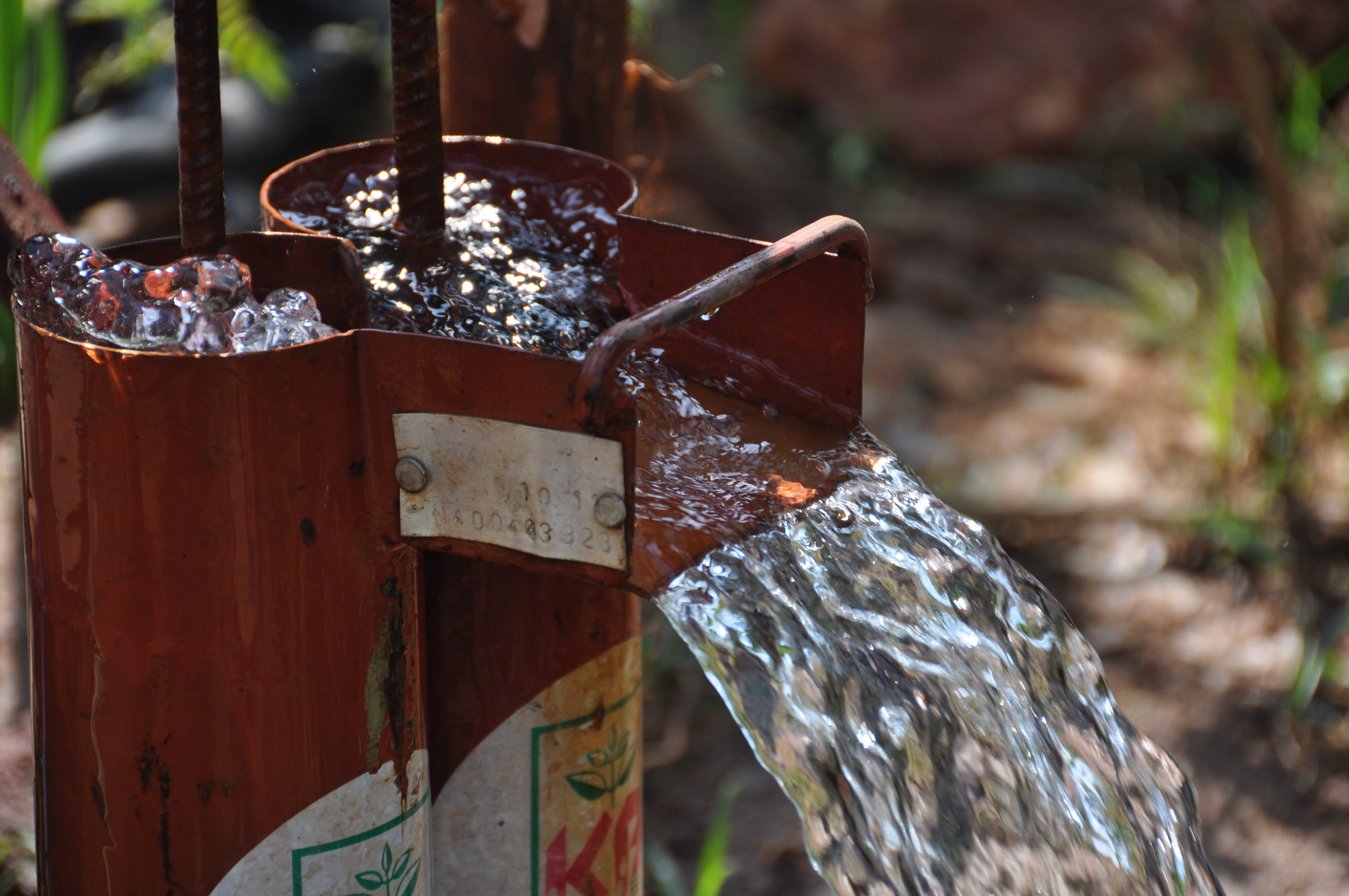
The last time I saw her in Africa, she was engaged in a low cost well drilling exercise.  As you can see, it was dirty sludge coming out of that well drilling unit.  That didn’t matter to Ashley.  She already had dirty hands.  It was what qualified her to make an impact.

Ashley is only one of many qualified employees and volunteers who work with iDE.  They
come from around the world, many of them from the countries in which we operate.  Not all of them have dirty fingernails, but all of them are determined to make the world a better place for the smallplot farmers who are our clients.

Posted in IDE, Personal | Tagged , , , , , , | 4 Comments

A community of investors

iDE has been going through a rebranding process.  This is not just about visual identity, but also in terms of how we think about ourselves, our work and the people we interact with.  Along the way, we have decided to go with the word mark as illustrated. 

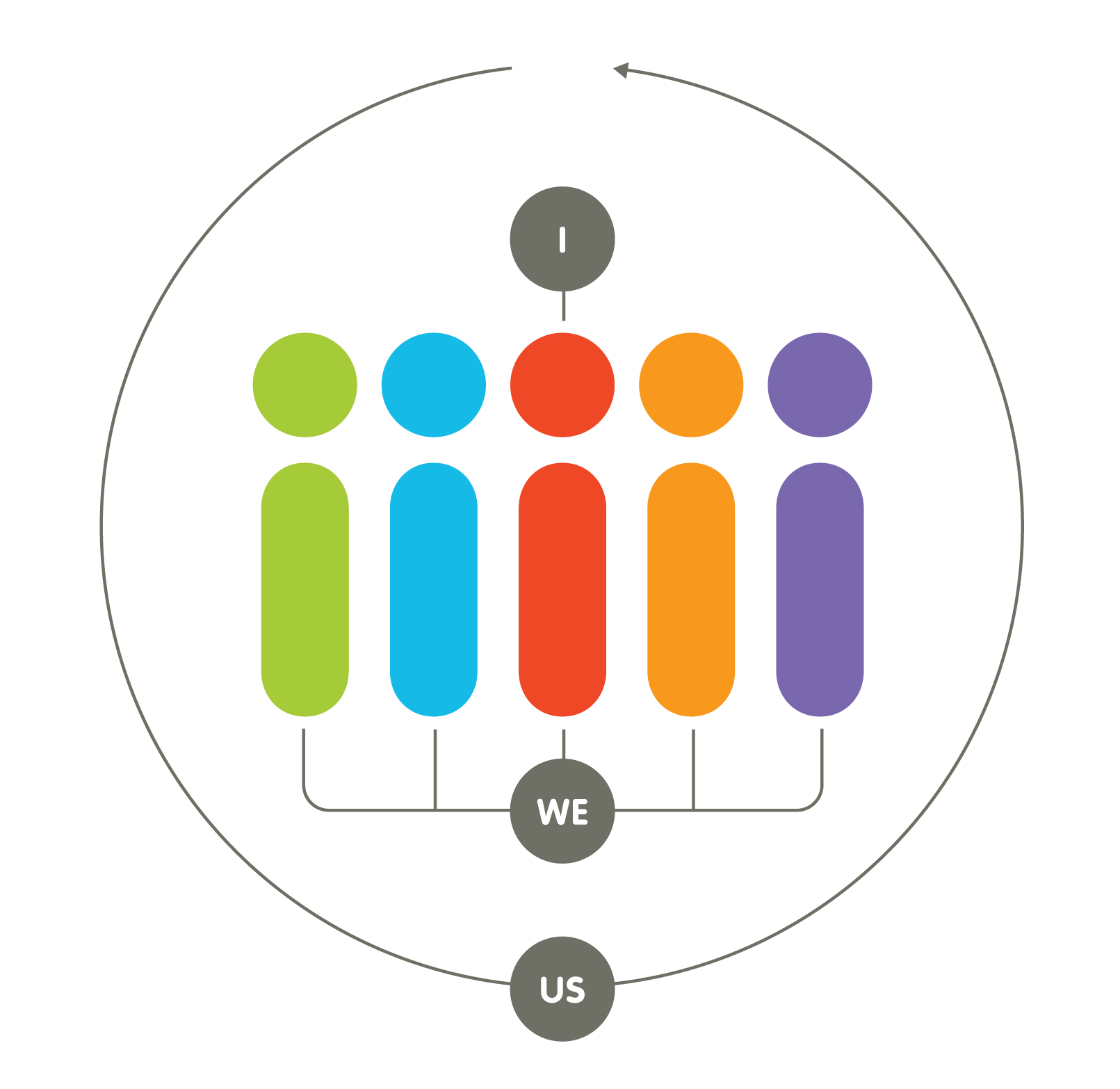
The distinctly colored lower case “i” represents a lot of ideas we want to be known for:  innovation, integrity, international, intentional, income, irrigation, impact, imagination, and the list could goes on to include investment.

We have developed a little graphic with multiple “i’s”.  An “i” alone represents me; it starts with what I believe is necessary and possible and what I am prepared to accept responsibility for.  This is not an individualistic organization, however, the multiple “i’s” become “we”.  We share a common belief system, a common philosophy of development, a common commitment to action … and we understand that when we believe and act together, things happen.

To take it further, we understand that we are a community of investors.  You can see us in the graphic – some diversity to be sure, but there we are lined up shoulder-to-shoulder in common cause.   

Each of us are investors.

Our donors invest in our mission because they believe and desire that we will create a social return on that investment which results in income and livelihood opportunities for the rural poor.

Our staff invest their careers and time in pursuit of a mission which is driven by the same desire for a social return.  We believe that the efforts we invest in innovative product development and rural marketing programs will pay off.

Our interns and volunteers invest their time and passion to join us; the leverage they bring is not inconsiderable.

Our supply chain partners invest working capital to source and/or manufacture treadle pumps, drip systems and sanitary latrines because they believe in the underlying value of those products; that value to include the margins to keep the supply chain profitable and sustainable.

And most importantly, our small plot farmer clients invest their meager resources to acquire and put to work technologies which will increase their productivity and production, and their disposable income.  We have learned a long time ago that small plot $1/day farmers require a payback which, in most cases, is less than a year.  Generating this return is primary for us.

So we are a community of investors.  We partner to achieve common purpose.  Each of us has something at risk; each of us has a particular desired return on that investment.  When we recognize that we are a community of investors, thoughts of paternalism disappear.  So do characterizations of our small plot farmers as beneficiaries. 

All of us in iDE are investors.  We stand together, and together we achieve a considerable return on those investments.  Some call it ROI.    And that is good for all of us.

Al Doerksen

Posted in IDE | Tagged , , , , , | 4 Comments

Water into wine

Tuesday is World Water Day.  iDE is planning to launch a new program to turn water into wine; a replication of the famous miracle at the marriage celebration feast at Cana several centuries ago.  To explain how we will do this, and actually, how we are doing this already, I have to start with this last week’s visit to the state of Orissa in India.

It is many months past the monsoon season in India, and the season for rain fed agriculture is also long past.  By far, the majority of fields are laying fallow waiting for the next monsoon, still some time away.  In Phulbani, however, there are more than a few enterprising smallplot farmers who have dug open wells on their own one acre farm sites.  The next thing is to add a surface treadle pump, a simple and inexpensive device which lifts the water out of the well – water which is a key ingredient for irrigation, and also the miraculous transformation to wine.

The results are dramatic:  Aubergines, potatoes, beans, chilies, cabbages, cauliflours, tomatoes, okra – we saw them all.  No grapes but we will get to that.  These horticultural crops are carefully tended with local organic fertilizer applied.  Weeding is manual.  The result is three crops annually in place of the usual single rain fed crop.  Annual farm income goes from $200 per family member to $600 per person; for the family of five approaching $4000 from one acre of land.  In nominal terms, that makes these farmer almost $2/day; still poor but no longer at the subsistence level.  Children are going to school.  Family nutrition has become a lot more adequate.  There is no longer the need to migrate in search of day labor opportunities in the dry season.  There is even a little money left over for jewelry and cosmetics – witness the feet of the female farmer on her treadle pump.  These are great indicators.

Now to the wine dimension.  Also cultivated to a small extent around the edges of the field is a small fruit which is ideal for a local fermentation process.  The result is somewhat akin to wine.  iDE is not promoting home brewing per se, but we do realize that people around the world like to celebrate their farm successes, and doing so with a little wine, homebrew or local hooch is rather common.

It starts with water.  In so many part of the world, providing access to irrigation water and accompanying technologies for lifting and distribution is the single greatest point of income leverage for small plot farmers.  iDE develops these technologies, and arranges for their distribution through local market channels.  Local farmers assess the opportunities, invest and harvest the results.  Worth celebrating?

May I offer you a glass of wine to celebrate World Water Day?

Posted in IDE, Personal | Tagged , , , , , , | 2 Comments

Small plot farmers and discarded sofas

One of my favorite concepts is that of “value.”  It is a word we use a lot at iDE.  Value chains.  Value streams.  Value proposition.  Shared value.  Value selling.  Customer value.  Value added. 

So here’s a few thoughts about value.  I start with the dead sofa on the boulevard of a Fort Collins neighbourhood – not that far from Colorado State University.  I had occasion to visit Fort Collins several times over the space of a week or so.  The sofa did not move; it was just there.  No, it wasn’t a bus stop.  It was just discarded.  There was even a sign which said FREE.  Still, there wasn’t even a university student on a limited budget who laid claim to it. 

Since I spent half a dozen years in the upholstery business, I am sensitive to discarded sofas.  In this case, the frame looked more or less intact, the fabric a bit dirty but not visibly torn.  The cushions probably required replacing and a face plate on one of the arms was missing.  To build a new sofa of that style would cost a few hundred dollars, at least; in the factory, we would go through a series of steps which we would consider to be value added, and end up with a product which would retail for a modest profit.  The sofas we built had value, and yet, this one sits here free, discarded, unclaimed – apparently it has no value to anyone.

So here is the first observation.  It is not the cost build up which determines the value of a product.  It is customers who do their own mental assessment of what the perceived features and benefits are worth to them.  In this case, there was no one around who perceived anything which seemed remotely attractive or interesting.  Worthless in other words.

The definition of value is the ratio of perceived features and benefits relative to price.  New HighDefinition television sets and new cars and countless other products are now available in a wide range of pricing.  Yes, you can simply choose the lowest price product, and some people do, but many more consumers are do the value calculation – which features and benefits appeal to them within their ability or willingness to purchase.

These features and benefits may be warrantee, color, functionality, status, versatility, reputation, power consumption and a bunch of other factors.  Each customer has her or own value paradigm.  Successful companies, for example, Apple, understand a lot about customer values in how they put together and market their iProducts – iPads, iPhones, iMacs and iPods.

iDE’s customers are small plot farmers.  The better we understand the value framework and farm economies of those customers, the more likely it is that we will offer products and services which align with those values.  We can discover these value frameworks by simply observing the market response to our offerings, or we can undertake formal voice of customer exercises.  Apple does it.  Why shouldn’t iDE?

One of the things which iDE has learned from the 3.8 million small plot farmers we have served so far is that each and every one of those farmers is “sitting” in the middle of a value stream.   Costs flow into the farmsite from upstream sources.  Revenue opportunities for farm production are found in downstream markets.

We have not tried very hard to sell upholstered sofas to small plot farmers.  Not only is it not our business, we doubt that the value proposition embedded in sofas would rate very high for subsistence farmers.  I am sure we would fail.  What does rate much higher are irrigation products and other agricultural products and services which dramatically increase family income.

In terms of water lifting, farmers have more and more choices:  treadle pumps, photovoltaic pumps, solar thermal pumps, electric pumps or diesel pumps.  Each has its own set of features and benefits.  Our farmer customers make their own assessments.  They each also review what their farm economy can afford.  Then they make their own value choice.

Posted in IDE | Tagged , , , , , | Leave a comment

There’s no fortune at the bottom of the pyramid

Sorry to break it to you.  There is no Santa Claus.  There is no pot of gold at the end of the rainbow.  And there is no fortune at the bottom of the pyramid.  There is only grinding poverty.

It was the late C.K.Pralahad who first popularized the notion of a fortune at the bottom of the pyramid.  For him it was a business proposition.  His key observation was that there were a lot of poor of customers who had not been served by major corporations with goods for sale.  His contention was that if businesses were to develop products and sales methods targeted for the poor, they (the corporations) could reap major fortunes.  Conceptually interesting, but not much evidence so far.

According to that inscrutable source, Wikipedia , “the phrase “bottom of the pyramid” was used by U.S. president Roosevelt in his April 7, 1932 radio address, The Forgotten Man, in which he said ‘These unhappy times call for the building of plans that rest upon the forgotten, the unorganized but the indispensable units of economic power…that build from the bottom up and not from the top down, that put their faith once more in the forgotten man at the bottom of the economic pyramid.’”

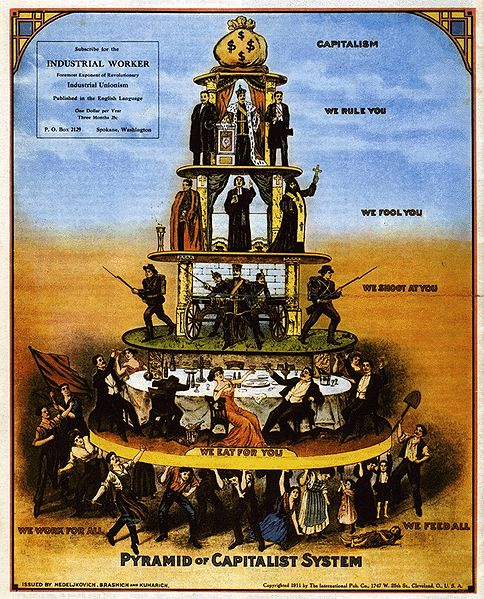
For those tending to hold negative view of capitalism, the space of the bottom of the pyramid has always been crowded, with the weight of all those above truly crushing in terms of impact.  In this illustration from the “Industrial Worker”, it is those at the bottom who “work for all” and who “feed all”.

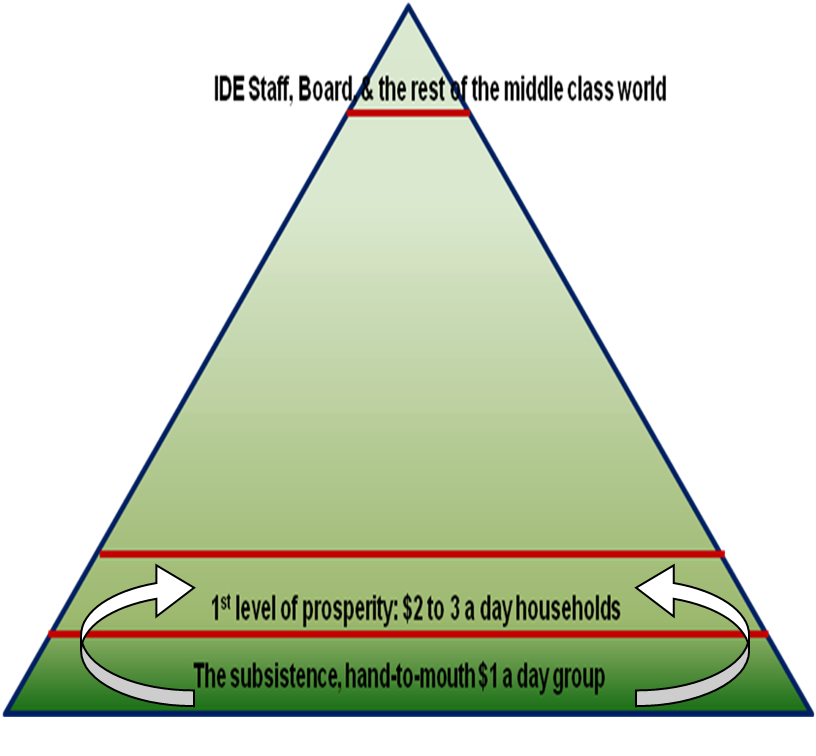
The more current usage refers to those people living on less than $1 – 2 per day.  An estimated 1 billion (plus or minus) occupy this space at the base of the pyramid.  Yes, it is crowded, and more than a little discouraging.  At less than $1 per day, life is mostly about subsistence poverty.  It is about barely having enough food to eat.  It is about inadequate health care.  It is about inadequate shelter for one’s family.  It was about not being able to educate some or all of the children in the household.  It is about having no savings.  It is about no fallback or cushion if crops fail.  It is about having no contingency funds for emergencies.  It is about having almost no ability for any kind of discretionary spending.  There are no fortunes down at the bottom of the pyramid.  It is hand to mouth.

IDE works with households and individuals who are poorest of the economically active segments of rural society in developing countries.   IDE does work at the bottom of the pyramid.  For farmers, it is about transforming the economics from scarcity to opportunity; and the mindset from object of charity to producer of value.  We do agree with Pralahad on the point that we should treat the people at the base as customers.  As customers, our intent is to offer them affordable income opportunities which allow them to sustainably move beyond the subsistence space to that first level of prosperity.  An annual income increase of $300 to $500 makes a world of difference.  No, they are not rich yet and they are not amassing fortunes, but now there is ability to get ahead a little and gain a measure of economic security.

IDE’s low cost irrigation technologies – low cost pumps, drip systems, water storage systems – have dramatic impacts on agricultural productivity hence household income.  If we include other value stream opportunities relating to better or lower cost inputs (eg. seeds) and/or improved market access for horticultural produce, the results get even better.

As already noted, IDE’s goal is move these base of the pyramid producers / consumers sustainably up to at least that first level of prosperity in the economic pyramid.  In a perfect world, we would end up with an empty space in that $1/day space at the bottom of the pyramid.

A phrase we often use to describe our work is “Enabling Rural Prosperity.”  We do not mean exactly that these poor rural households have become rich.  What we mean is that our farmer investor friends are moving away from subsistence grinding poverty in the direction of the entry levels of economic security.

And why do we insist on treating very poor people as customers?  It is not to generate any fortune for ourselves.  When we treat poor people as customers, we commit ourselves to listening and responding to what they need to become more productive and earn more income.  Anybody can give stuff away free.  It is when we can create investment opportunities with quick returns that we can take the first steps to creating those illusive fortunes at the base of the pyramid.  Once we achieve that, we will move to rainbows.

Posted in IDE, Personal | Tagged , | 1 Comment